
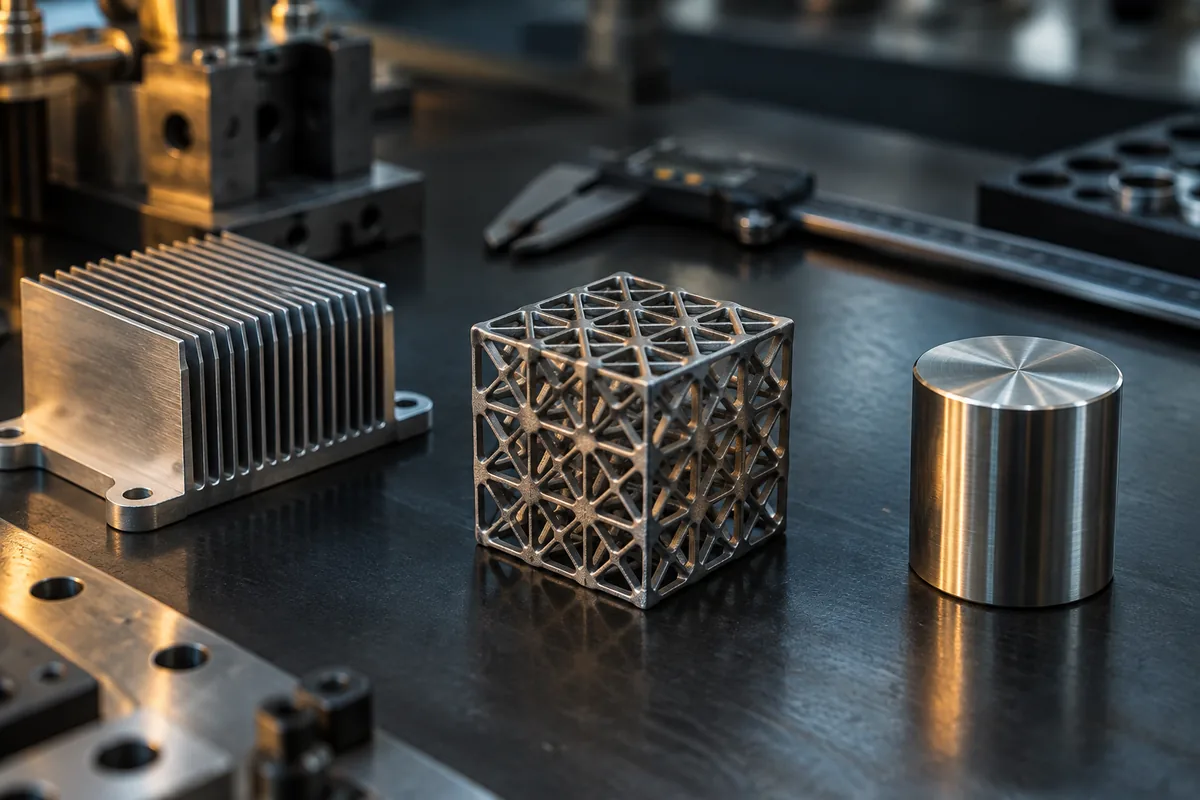
- Your challenge
- The properties or design choices available today cannot satisfy your application’s combined requirements.
- How we help
- Explore new candidates, prototype critical interactions and refine the route to repeatable manufacture.
- What you gain
- A differentiated material or design concept supported by application evidence and a realization plan.
Create a possibility beyond the current design space
A product brief can demand a combination of properties that current options struggle to deliver. Lower mass may conflict with stiffness, compactness with heat management, or circular inputs with consistent processing. The development opportunity is often found in the interaction between material, geometry and use rather than in a single isolated property.
DeploySci helps investigate that interaction and create candidate materials, formulations or designs around it. We start with the intended function and the conditions the concept must survive. Your brief identifies what prevents the existing design from meeting the need and the technical freedom available to develop an alternative with a meaningful advantage.
Map constraints and research the unexplored routes
We examine current designs, test results and the assumptions behind the specification. Some requirements express a true functional need; others reflect the limitations of the existing solution. Distinguishing them can reveal a more productive design question and expand the space of possibilities without compromising essential performance.
Research compares relevant scientific approaches, available materials and feasible manufacturing routes. Modernization may involve retaining a working assembly while redesigning the part that limits it. Where discovery is required, we define the relationship that needs investigation and the evidence needed to support a new concept. The outcome is a clear development opportunity rather than an unrestricted search for novelty.
Extract value from the complete application
The proposition connects a candidate design to what the user or manufacturer gains. This might be a function that fits within a tighter envelope, a product that remains useful under harsher conditions or a design that tolerates a broader input range. The improvement must be meaningful in the complete application and compared with a suitable existing alternative.
We assess trade-offs with your team, including fabrication, assembly, inspection and service. A design that performs well but cannot be produced consistently needs further development before its value can be realized. These constraints shape the research from the start and help position the result as a practical product or process opportunity.
Discover candidates computationally
The virtual lab helps explore how candidate choices affect the target function. Depending on the question, this can involve physical simulation, data-supported estimates and searches across constrained design options. We match the approach to the available evidence and the decision rather than assuming a detailed model is always necessary.
The analysis identifies promising directions, sensitive assumptions and reasons a candidate may fail. We compare alternatives on the requirements that matter and use uncertainty to guide the next physical test. Your team receives a reasoned shortlist and a clearer explanation of what each prototype must establish, with proprietary design choices developed within the agreed confidential programme.
Build samples and prototypes that answer the question
Physical prototypes examine the behaviour that predictions alone cannot establish. The useful test article may be a material sample, a representative interface or a functional component. Its form is chosen to preserve the mechanism responsible for the proposed advantage and expose the conditions that could undermine it.
Laboratory testing investigates repeatability, relevant exposure and compatibility with the intended surroundings. Suitable specialist facilities are used where needed. Findings feed back into the next design iteration and can revise the value proposition if a different performance balance proves more useful. The prototype becomes a source of development knowledge and a tangible basis for evaluation by your team.
Connect the concept to repeatable realization
A design strategy must account for how the result will be made and used. We examine fabrication routes, material variability, supplier participation and the interfaces with surrounding components. A change in scale or manufacturing method may require additional prototypes to establish that the intended behaviour is preserved.
The realization plan links those questions to staged trials and an initial application. It identifies where ordinary engineering is sufficient and where uncertainty still requires R&D. Your team can assess the next commitment with a clearer view of the work between a successful sample and a repeatable capability, including the partners needed for manufacture and qualification.
Transfer the design and the basis for trusting it
Your agreed deliverables can include candidate designs, prototype results, comparative evidence and a development or qualification plan. The record explains which requirements have been supported and which need further work. Technical assets are transferred according to agreed ownership and access, with enough context for the next team to understand the design intent.
Where deployment is included, support extends to representative trials, refinement and handover. Value is assessed through accepted application performance and practical repeatability. The intended result is a new material or design option with a supported reason to exist and a route to becoming part of a product, process or service.
What would progress look like?
Tell us what needs to work better and where the technical uncertainty sits. We will help define a focused R&D, prototype or deployment engagement.
Get Started↗