
- Your challenge
- You have research with potential, but its strongest application or development route is still unclear.
- How we help
- Application assessment, value-proposition development, laboratory prototyping and partner-ready development planning.
- What you gain
- A more credible application proposition and evidence that helps the next adopter or partner engage.
Identify the application in which your finding matters
Promising research can support several possible uses, but they may differ substantially in need, development effort and evidence requirements. A result that is novel in the laboratory may be difficult to adopt, while a less obvious application could offer a clearer benefit. Choosing the application is itself a research and development question.
DeploySci helps your team examine where the distinctive behaviour or capability addresses a meaningful gap. We begin with what the evidence establishes and the conditions it depends on. The aim is to identify an application worth developing without reducing the science to a premature product claim or assuming that technical novelty alone creates demand.
Research the user’s problem and existing alternatives
Application research looks at the task an adopter performs today, the limits of current approaches and the consequences of those limits. We examine whether your finding addresses the part of the problem that constrains progress, and what a user would need to change to take advantage of it. This helps distinguish a plausible use from a compelling development opportunity.
Gap analysis compares research conditions with the intended environment. Sample preparation, material availability, instrument dependence and interpretation effort can become important translation barriers. We also consider opportunities to modernize an existing tool or process with your capability. Your team receives a reasoned comparison of applications and the unanswered questions that determine their suitability.
Refine a proposition an adopter can understand
The proposition describes the change the research could make for a specific user, compared with the alternative available today. It connects a scientific advantage to practical value such as a previously inaccessible measurement, more interpretable evidence or a process that can tolerate a difficult condition. The benefit is framed at the level an adopter can evaluate.
We distinguish demonstrated capability from development ambition and identify what evidence would strengthen the proposition. This supports productive conversations with prospective partners: what is useful, what remains unresolved and what participation is needed. Your public description can explain the problem and intended benefit while confidential methods and unpublished details remain within agreed disclosure arrangements.
Design research that closes the application gap
Translation may require new discovery as well as engineering. A mechanism established under controlled conditions may behave differently in a representative sample, or a research method may depend on information that an adopter cannot obtain. We define these questions explicitly and use the existing scientific evidence to choose the next investigation.
Computational exploration can help compare candidate applications, examine sensitivity and guide experimental design. Laboratory work then tests the interactions that matter to use. This creates a two-way relationship between discovery and application: practical requirements sharpen the research, while new findings can reveal a better use or a more credible initial scope.
Build a demonstrator that a prospective user can assess
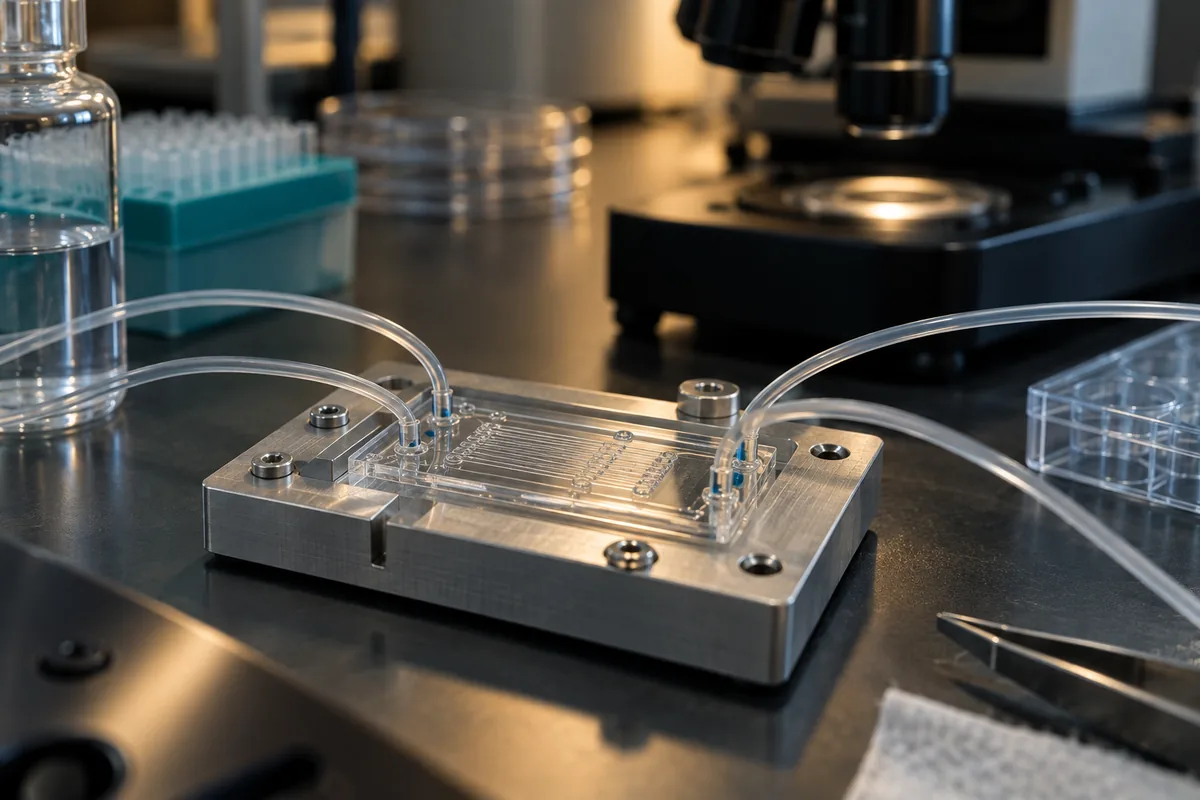
An application prototype should preserve the research advantage and reproduce enough of the user’s task to evaluate it. This may involve a representative sample workflow, an instrument interface, a material demonstrator or a computational tool. The scope is chosen to answer a translation question rather than to imply that every product-development requirement has already been met.
We plan controlled evaluation with relevant users or partners where available. The work examines repeatability, practical handling and interpretation as well as the core scientific result. Specialist laboratory support is arranged as needed. Your team gains a demonstrator and evidence that can inform the next collaboration, including a clear account of the capabilities still to develop.
Choose a realization route that fits the opportunity
The next route may involve an industry partnership, a research tool, a product-development programme or support for a new venture. We assess these options against the intended user, remaining technical work and the capacity required to deliver. An application that depends on specialist manufacture or evaluation needs those partners represented in the plan.
Responsibilities for further research, engineering, access and transfer are made explicit with your institution or organization. The strategy identifies a credible first use and the evidence needed for a broader application. This helps position the work for a partner who can contribute to realization rather than simply expressing interest in the underlying science.
Carry the research into a usable development package
Your agreed package can include an application assessment, refined value proposition, demonstrator, evaluation record and development roadmap. It explains the basis for the chosen application and the requirements still to satisfy. Technical assets and confidential information are handled according to the collaboration’s ownership, publication and access arrangements.
Progress is measured through the quality of the application evidence and readiness for the next adopter or partner. DeploySci can continue into prototype refinement, pilot support and implementation with the appropriate delivery team. The goal is a credible path from research capability to useful adoption, with the science and its evidence preserved throughout the transition.
What would progress look like?
Tell us what needs to work better and where the technical uncertainty sits. We will help define a focused R&D, prototype or deployment engagement.
Get Started↗