
- Your challenge
- A biological process, research tool or health-related concept needs stronger performance or a clearer route into use.
- How we help
- Application assessment, biological R&D, laboratory prototypes and validation planning with the expertise appropriate to the intended use.
- What you gain
- A more useful proposition, better development evidence and a clear next step towards adoption.
Define the application behind the biological promise
A biological finding becomes a development opportunity when it helps a particular user do something that is difficult today. Your challenge might be an enzyme that loses useful activity in a process, a sample workflow that introduces inconsistent measurements, or a research instrument that takes too much specialist effort to operate. Each calls for a different programme, even when the underlying science is related.
DeploySci helps you refine the intended use before selecting the development route. We distinguish scientific uncertainty from limitations in sample handling, measurement, product design or workflow. Your team receives a problem definition that states who benefits, which decision or process should improve and what evidence is needed to support that change in the environment where it will be used.
Investigate the gap between controlled results and use
We review the available research, earlier experiments and the practical context of the application. Particular attention goes to variation in biological material, differences between test conditions and intended use, and dependencies hidden in specialist preparation. Conflicting results can point to an important boundary rather than a reason to average away the disagreement.
For modernization, the opportunity may lie in making an existing assay or bioprocess more reproducible and easier to use. We examine where information is lost between preparation, measurement and interpretation, and whether a change in instrumentation or workflow would resolve the barrier. This research helps you avoid developing a sophisticated component while leaving the actual source of unreliable results untouched.
From bioprocesses to research and human use
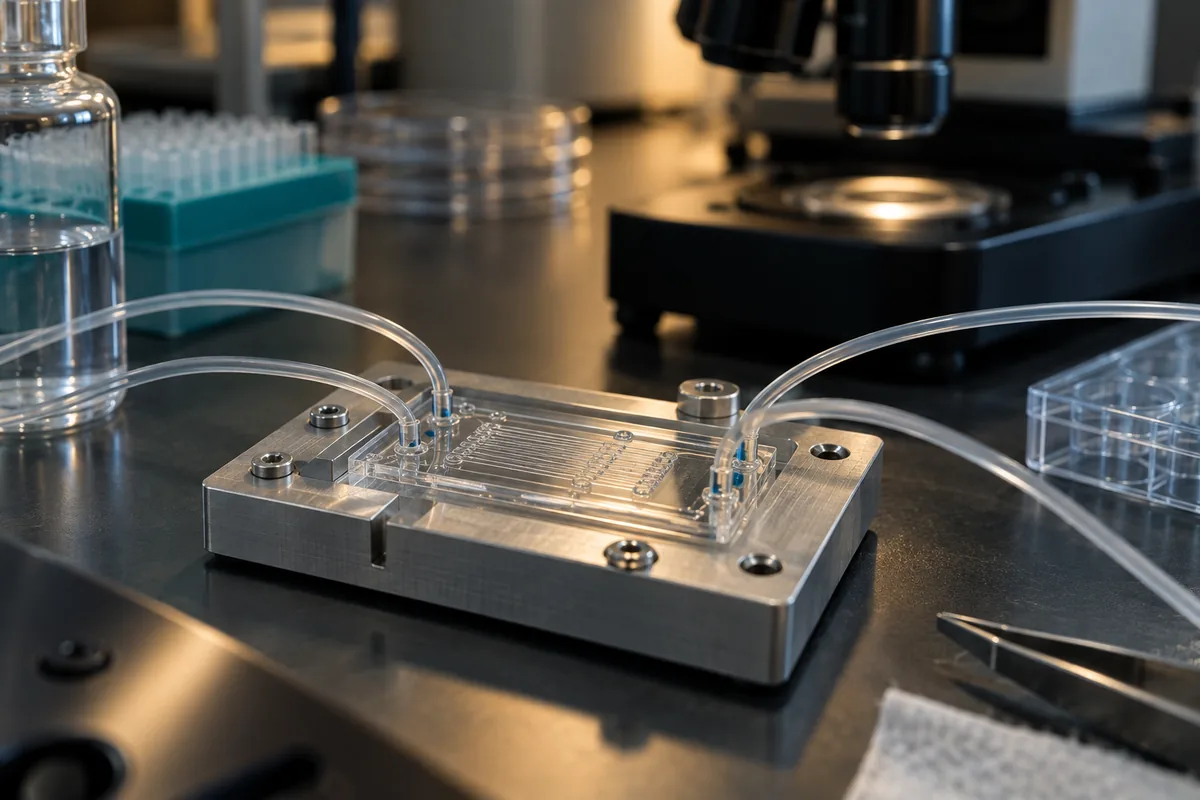
Enzyme and fermentation development can require evidence about stability, variable inputs and the steps between biological production and useful output. A research-tool programme may instead focus on assays, sample preparation, microfluidic handling or the interpretation of a measurement. We frame each around its intended application so that the research question reflects the actual obstacle to adoption.
For health, wellbeing and human interaction, the development task also includes how people encounter and use the proposed solution. We consider usability and the environment alongside the scientific concept, with specialist oversight and evaluation appropriate to the intended use. The programme makes clear which capabilities are being researched and which claims would require additional evidence before they could support a product offering.
Frame a benefit the adopter can evaluate
Useful value propositions connect biological performance to the adopter’s work. For a research tool, that could mean more interpretable measurements, fewer repeated preparations or a clearer basis for comparing experiments. For a bioprocess, it could mean maintaining acceptable output under variable inputs or reducing a difficult downstream step. The benefit must remain meaningful after the work leaves controlled development conditions.
We define the comparison, practical constraints and evidence with your team and intended users. Research performance, usability and any health-related claims are treated as separate questions. Where the intended application requires clinical, quality or regulatory expertise, that work is scoped with the appropriate specialists. A research demonstrator is presented for the use its evidence actually supports.
Use computation to focus experimental discovery
Computational work can help organize biological evidence, compare candidate mechanisms and explore sensitivities in a process or measurement system. We select the approach around the decision and the quality of the available data. Models may guide which candidates deserve laboratory attention, but uncertainty and the limits of transfer between conditions remain visible throughout the programme.
Your virtual lab provides a structured way to test alternatives before committing scarce samples or specialist equipment. It can connect data analysis, process models and experimental planning so each physical result informs the next comparison. The purpose is to improve the relevance of laboratory work and uncover useful directions for development, with biological measurements providing the necessary reality check.
Prototype the interaction that determines usefulness
A prototype may be a research workflow, an instrument interface, a small process demonstrator or a biologically enabled product concept. We choose its scope around the unresolved interaction: sample and sensor, organism and process environment, or user and output. Physical work is arranged with suitable laboratory partners, equipment and oversight for the agreed material and intended use.
Testing examines repeatability, relevant variation and the conditions that produce misleading or unusable results. A promising component is also evaluated within the wider workflow, including preparation and interpretation. Your team gains evidence about practical usefulness and a clearer explanation of what still needs development, rather than a single performance figure separated from the conditions that produced it.
Plan translation, scale and specialist participation
The route beyond the laboratory depends on the application. A bioprocess may require representative feedstocks, stability studies and investigation of downstream recovery. A research tool may require compatibility with existing instruments, traceable analysis and support for non-developer users. A health-related product needs an evidence and development route appropriate to its intended claims and users.
We identify these dependencies early enough to shape the prototype. The development strategy names the next user, the environment for evaluation and the partners needed to realize the result. It also distinguishes the work DeploySci will deliver from manufacturing, specialist evaluation or other responsibilities held by your organization and partners, so the transition has a practical owner.
Transfer a capability with a clear evidence boundary
Deployment means that the intended team can use the result consistently and understand its limitations. We support scoped pilots, workflow refinement, documentation and training around that objective. Evaluation considers failed runs, unusual samples and user interpretation alongside successful operation. The handover explains the circumstances that require further review rather than treating all outputs as equally reliable.
Your agreed package can include an application assessment, prototype, comparative study, development record and transfer plan. Progress is judged by the intended benefit, reproducibility and readiness for the next use. The outcome is a stronger route from biological knowledge to a useful tool, process or product, with the scientific questions and specialist responsibilities made explicit.
What would progress look like?
Tell us what needs to work better and where the technical uncertainty sits. We will help define a focused R&D, prototype or deployment engagement.
Get Started↗