
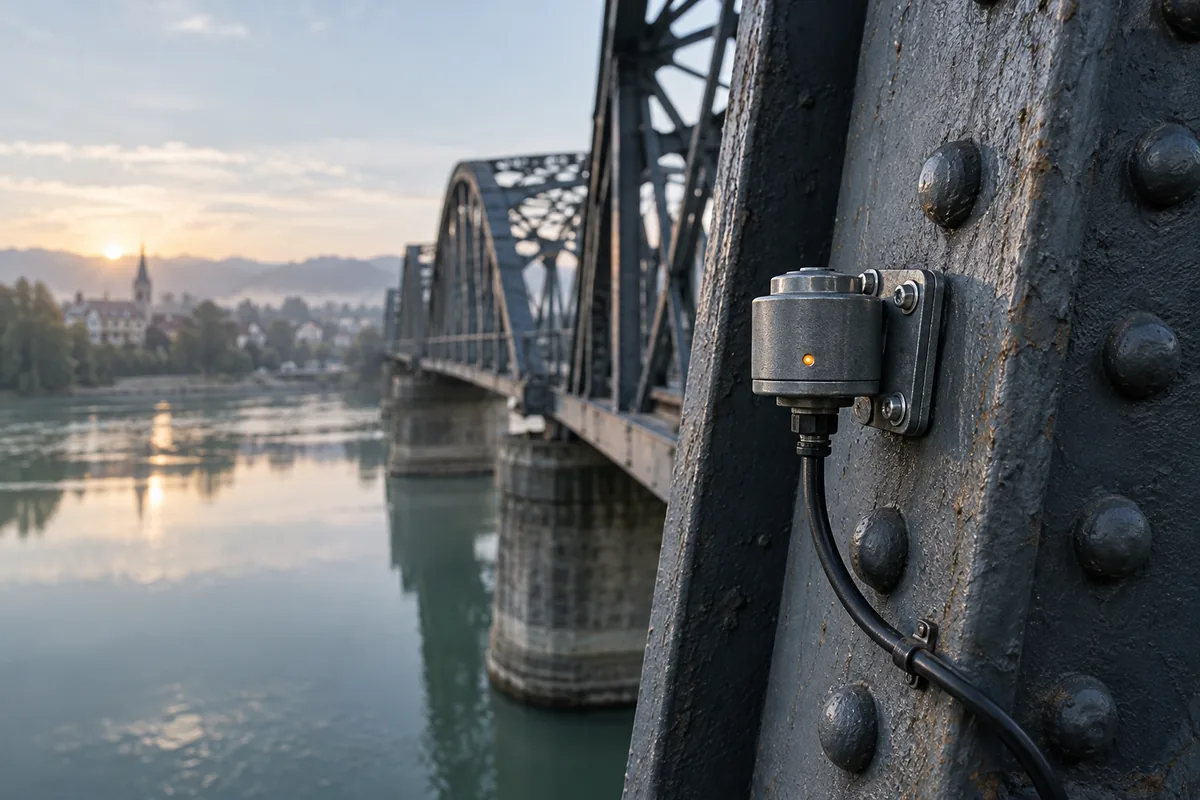
- Your challenge
- Incomplete observations or uncertain asset behaviour make it difficult to direct investigation and development effort.
- How we help
- Targeted evidence review, sensing and modelling development, field-trial planning and implementation support.
- What you gain
- A clearer basis for prioritizing work and a capability shaped for use in the field.
Begin with the asset decision that is difficult today
Infrastructure teams often have to act with incomplete observations. A water network may show unexplained losses without a clear investigation priority; a structure may exhibit changing measurements whose significance is uncertain; an energy asset may lose performance for several plausible reasons. More data alone does not establish what action is justified.
DeploySci helps define the decision your team needs to make and the information that is missing. We examine the asset context, existing inspections, operating history and the consequences of different actions. The research brief identifies where better sensing, modelling or interpretation could improve investigation and development, while preserving the role of the qualified professionals responsible for asset decisions.
Analyse gaps in coverage, context and confidence
A useful evidence review asks what the observations actually represent. Measurements may cover a limited period, depend on environmental conditions or be difficult to compare across instruments. A model may describe one loading or operating regime while the asset experiences another. We make these gaps explicit before presenting a more complex analysis as a solution.
Research considers available sensing methods, relevant physical behaviour and practical constraints such as access, power, communications and maintenance. Modernization may mean making better use of existing records or adding a targeted measurement where it can change an investigation. Your team receives a clearer view of the uncertainty and a comparison of development routes suited to the asset.
Water networks, structures and energy assets
Water-network work can investigate unexplained losses and help prioritize where additional observation would be useful. Structural applications can connect movement or condition measurements with relevant engineering context, without treating an isolated signal as a complete assessment. Energy-asset work may examine changing output or the conditions affecting continued performance.
Resilience can also require development of materials or adaptations for changing exposure. We help define the service conditions, compare candidate approaches and establish what a representative test must show. The application may therefore involve a monitoring capability or a physical intervention; in each case, the strategy connects investigation to the team responsible for evaluating and acting on the result.
Position value around better-directed action
The value proposition connects the new capability to a decision: where to inspect first, which change deserves specialist investigation or how to assess a proposed intervention. We define who will act on the result and what evidence they require. A useful output must be interpretable alongside existing inspection and engineering practice.
Success measures might include the relevance of investigation priorities, the quality of corroborating evidence, coverage of a difficult condition or effort required to maintain the measurement. We avoid equating a model score with an asset-level conclusion. The intended benefit is more effective use of engineering attention and development resources, with uncertainty communicated in a form the responsible team can use.
Explore asset behaviour through computational research
Computational work brings together observations, physical models and scenario analysis to investigate possible explanations for the signal of interest. For a water network, this might involve examining how operating changes affect the interpretation of measurements. For a structural or energy asset, the task may involve separating expected variation from patterns that warrant closer investigation.
Virtual experiments help identify which observations would distinguish competing explanations and where a proposed sensing approach may be weak. We examine missing data and uncertain assumptions as part of the analysis. The output is a reasoned test plan and a clearer basis for selecting instrumentation or a prototype, rather than a claim that a virtual representation fully describes the real asset.
Prototype the measurement and the decision support
Laboratory or controlled trials investigate whether the relevant phenomenon can be observed consistently with a practical setup. We assess the interaction between the sensor, its installation and the conditions that could obscure the signal. Where a physical analogue is useful, it provides a way to evaluate parts of the concept before field access becomes necessary.
The prototype also tests how information reaches the intended user. A technically sound signal may still be difficult to interpret without context, an explanation of uncertainty or a route for requesting further investigation. We refine the measurement and presentation together so that the result supports a defined professional workflow. Specialist test facilities and field partners are scoped around the application.
Plan field realization under real constraints
Field deployment adds questions about installation, environmental exposure, connectivity, access and long-term ownership. We develop the strategy with the people responsible for the asset and its inspection or maintenance programme. The first field use is chosen to establish a specific capability under representative conditions, with clear comparison evidence and boundaries on how outputs will be used.
Integration may involve existing records, reporting practices and maintenance arrangements. We identify the responsibilities for installing, checking and replacing components, reviewing outputs and responding to unusual conditions. This planning makes the proposed benefit more credible because the capability is assessed as something the organization can operate, rather than as a sensor demonstration in isolation.
Carry the evidence into an owned capability
Acceptance considers measurement quality, useful interpretation and performance across the relevant operating conditions. We help document what the trial establishes and where further evidence is required. Outputs that inform consequential asset decisions remain subject to the appropriate engineering review and authority for the intended application.
Your agreed package can include an evidence assessment, sensing or analysis prototype, field-trial record and transfer plan. Deployment support focuses on reproducible use, integration with existing practice and clear ownership of changes. The result is a better-supported investigation or monitoring capability, with a development path that can expand as evidence and practical experience justify it.
What would progress look like?
Tell us what needs to work better and where the technical uncertainty sits. We will help define a focused R&D, prototype or deployment engagement.
Get Started↗